
Before You Decide · May 1, 2026 · 6 min · By Gideon Maravilla
Thick Skin Rhinoplasty: What Surgeons and Patients Need to Know
Thick skin rhinoplasty presents unique surgical challenges that affect outcomes, recovery, and realistic expectations.
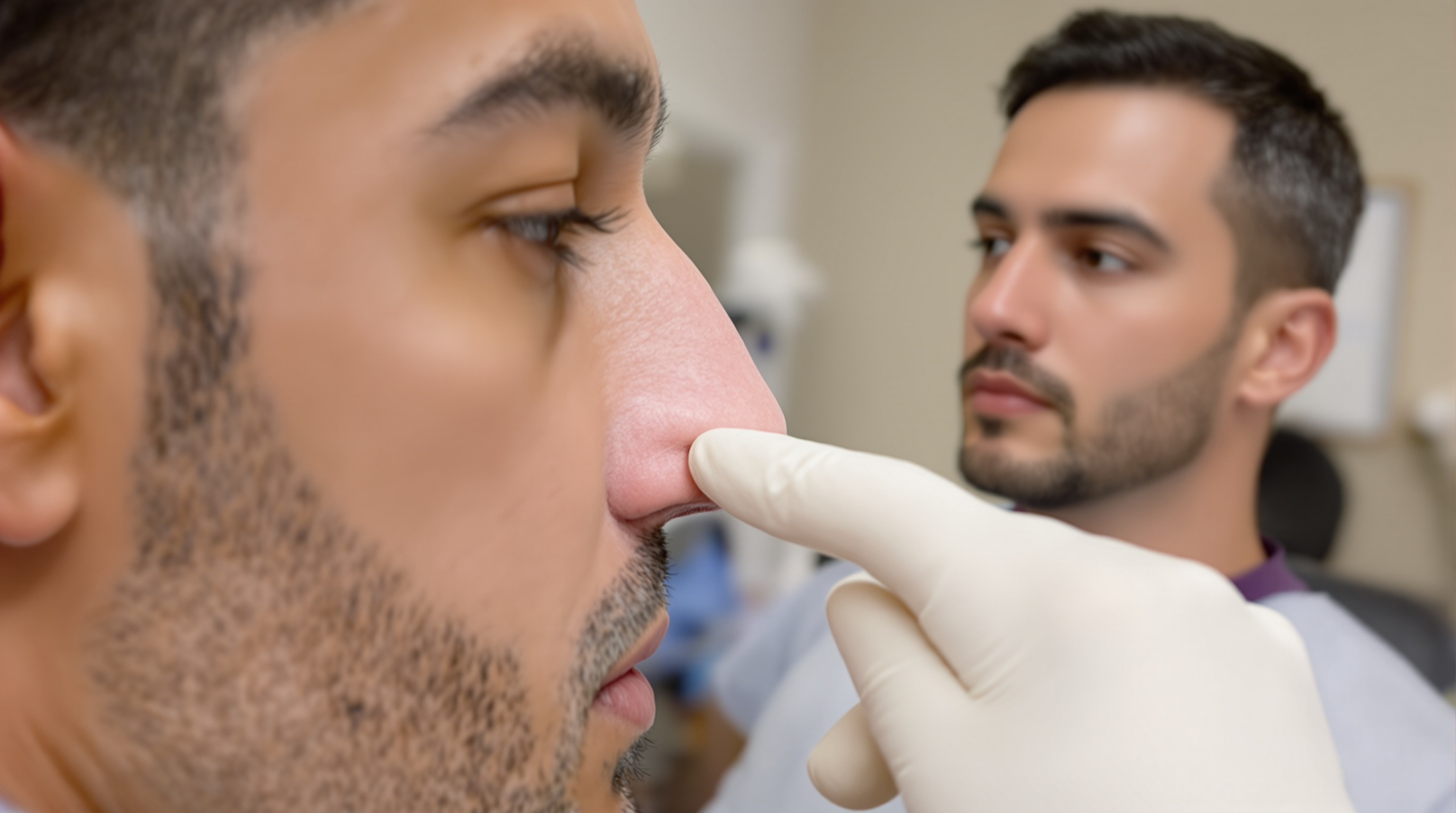
The skin envelope is one of the most consequential variables in any rhinoplasty, and patients pursuing thick skin rhinoplasty quickly discover that the surgical rules change significantly when the soft tissue is dense, sebaceous, or poorly contractile. Unlike thin-skinned patients, where even modest skeletal changes read clearly on the surface, patients with thick skin present a fundamentally different problem: the overlying tissue can mask refinements, resist redraping, and introduce swelling that persists far longer than most people anticipate.
Thick nasal skin is most commonly encountered in patients of Middle Eastern, South Asian, African, Hispanic, and Mediterranean descent, though it can appear in any ethnic background. The thickness itself is not one uniform property. Some patients have a robust dermis with normal subcutaneous fat. Others carry a heavy layer of fibrous tissue and active sebaceous glands beneath the skin surface. That sebaceous component is particularly significant because it contributes to persistent fullness at the tip, even after the underlying cartilage has been reshaped precisely.
From a surgical standpoint, the fundamental challenge is that the skin does not shrink-wrap tightly around a refined framework the way thinner skin does. When a surgeon reduces the dorsum or refines the tip cartilages, the skin must contract downward to reveal those changes. In thin-skinned patients, that redraping happens relatively quickly and faithfully. In thick-skinned patients, the skin may contract incompletely or unevenly, leaving fullness that obscures the result for many months or even years. This is not a failure of technique. It is the biology of the tissue.
Surgeons working in this space tend to approach the structural framework more assertively. Because the skin will soften and diffuse subtle changes, the underlying scaffold often needs to be more definitively altered to produce a visible surface effect. This means stronger tip suturing strategies, more deliberate cartilage grafting to project and define the tip, and sometimes the use of a columellar strut or extended spreader grafts to establish a firmer, more projectable framework beneath the soft tissue mass. The goal is to build a structure sturdy enough to push through the skin envelope rather than be buried by it.
At the same time, there are meaningful limits. Aggressive reduction of tip cartilage in a thick-skinned patient can backfire. If the skeletal framework is weakened too much, the heavy skin has nothing to drape over, and the result can be a boxy, amorphous tip that looks worse than before surgery. The clinical insight here is counterintuitive: thick-skinned patients often need more cartilage support at the tip, not less, even when the surgical goal is refinement. A strong, well-projected framework gives the skin something to conform to, which is the only reliable path to a defined tip in this tissue type. For a closer look at the specific techniques involved, tip refinement strategies are worth understanding in detail before any consultation.
Swelling timelines are also dramatically extended in thick-skinned patients. Where a typical rhinoplasty patient might see roughly 70 to 80 percent of the final result at three to four months, a patient with dense, sebaceous skin may still be carrying significant post-operative swelling at the six-month mark, with continued evolution stretching to 18 months or beyond in some cases. This is one of the most important points in pre-operative counseling, because patients who expect a standard recovery arc will inevitably be disappointed or alarmed during those middle months when the nose looks swollen and undefined.
Some surgeons use intralesional corticosteroid injections, typically triamcinolone acetonide at low concentrations, to accelerate soft tissue contraction in the post-operative period. The evidence base is not robust, but the clinical use is widespread. The injections are placed carefully into the supratip soft tissue to reduce fibrosis and encourage the skin to contract more faithfully over the cartilage framework. Timing and dosage require experienced judgment, since over-injection can cause skin atrophy, surface irregularities, or even necrosis in vulnerable areas.
Setting appropriate expectations before surgery is not just courtesy, it is a clinical obligation. Patients with thick skin should understand that their results will develop slowly, that certain degrees of refinement are genuinely beyond what any technique can reliably deliver, and that the difference between a realistic goal and an unrealistic one can determine whether the outcome feels like a success. The guidance at realistic expectations and imaging provides useful context for navigating those pre-operative conversations honestly.
For patients researching how experienced surgeons actually approach these tissue-specific variables, clinician-authored writing addresses the structural reasoning behind individualized surgical planning in considerable depth.
The honest summary is this: thick skin rhinoplasty is technically demanding, outcomes are less predictable than in thin-skinned patients, and the margin between a good result and a disappointing one is tighter. But it is not an unsolvable problem. Surgeons who understand the tissue, build the right framework, manage the post-operative period carefully, and counsel patients with precision can achieve genuinely meaningful changes. The key is matching the surgical plan to the biology of the skin, not to the idealized outcome a patient might bring in on a photograph.
More in Field Notes
View all →- The nasal cycle: why the blocked side switches, and the two week log that settles it
- A Three Part At Home Test for Where Your Nose Is Actually Blocked
- Nasal Taping After Rhinoplasty: What the Ritual Does and Does Not Do
- Alar Retraction: Why Nostril Rims Pull Up After Rhinoplasty and How It Is Corrected