
Procedure Guide · May 19, 2026 · 6 min · By Gideon Maravilla
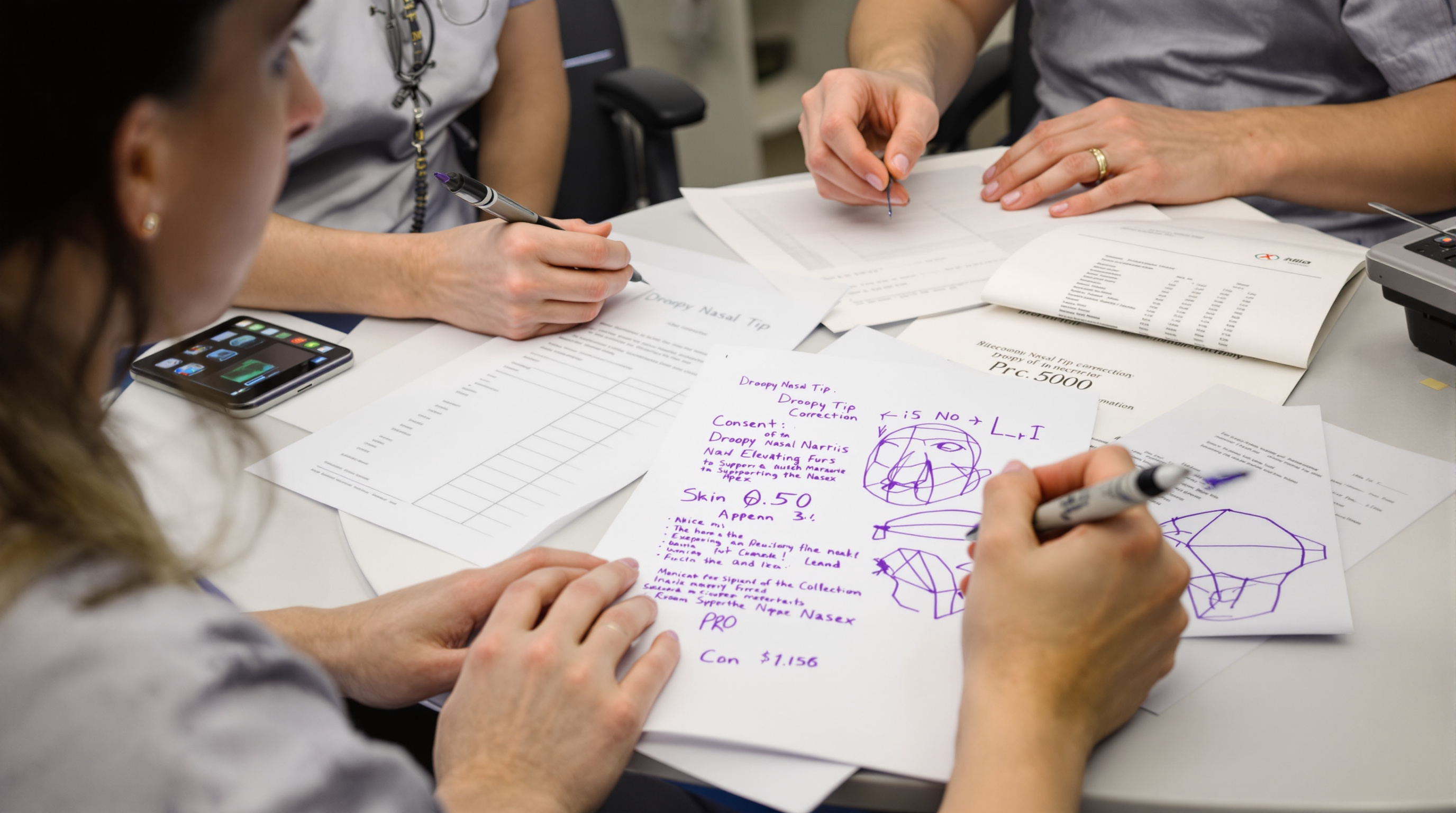
Droopy Nasal Tip Correction: Elevating and Supporting the Nasal Apex
Surgical and nonsurgical approaches to lifting a drooping nasal tip.
A droopy nasal tip is among the most frequently observed anatomical concerns in rhinoplasty consultations, affecting patients across age groups and backgrounds. Unlike structural problems that develop from trauma or developmental variation, tip droop often worsens with age due to loss of cartilage elasticity, weakening of supporting ligaments, and the effects of gravity on soft tissue. Understanding the mechanics of tip support is essential to discussing realistic correction options.
The nasal tip is supported by a complex network of cartilaginous and ligamentous structures that work in concert to maintain its position. The primary support comes from the lateral crura of the lower lateral cartilages, which extend from the tip region laterally and inferiorly. When these cartilages lose structural integrity or when the ligaments anchoring the tip cartilages to surrounding tissue weaken, the tip droops. In some patients, the problem is congenital: they were born with cartilages oriented in a way that points the tip downward. In others, chronic sun exposure, smoking, or simply aging weakens the supporting framework over decades.
The degree of drooping varies considerably. Mild tip droop might be barely perceptible, noticed primarily by the patient themselves. Moderate droop typically changes the nasal profile noticeably, creating the appearance of a longer nose or an overly rounded tip when viewed from the side. Severe droop can make the nasal base appear close to the upper lip, creating functional breathing issues in some cases. The vertical position of the tip relative to the alar base is called tip rotation, and surgeons measure it in degrees to quantify the degree of correction needed.
Surgical correction of a droopy nasal tip usually involves strengthening or rebuilding the supporting cartilage structures. One common approach is to suture the lateral crura in a repositioned orientation, which directly lifts the tip by anchoring it at a higher angle. This is frequently accomplished through a suture technique that tightens the cartilaginous framework without requiring cartilage grafts. Other cases require cartilage grafting, where material harvested from the septum or ear is shaped and positioned to provide additional support and elevation. The choice between suture techniques and grafting depends on the severity of droop and the thickness and quality of the patient's existing cartilage.
Tip refinement procedures frequently address drooping in conjunction with other concerns. A droopy tip often benefits from rhinoplasty tip refinement that narrows and reshapes the tip cartilages while simultaneously elevating and supporting them. When a surgeon removes excess cartilage or reshapes existing cartilage, the risk of postoperative droop increases, which is why proper support becomes even more critical in patients undergoing comprehensive tip surgery. The goal is a tip that is both refined in appearance and structurally stable for years to come.
For patients who prefer to avoid surgery or wish to explore less invasive options, non-surgical liquid rhinoplasty offers a temporary alternative. While dermal fillers and other injectables cannot actually lift a drooping tip structure, they can create the optical illusion of a higher tip by adding volume strategically to areas above or around the drooping segment. This approach works best for mild droop and requires repeat treatments every 6 to 12 months as filler gradually absorbs. Results are modest compared to surgery but carry significantly lower cost and recovery burden.
Recovery from surgical tip drooping correction varies based on the extent of manipulation. If the procedure involves primarily cartilage repositioning and suturing, swelling typically resolves within 2 to 3 weeks, with final results visible by 3 to 4 months. Procedures that include cartilage grafting may require slightly longer recovery, as the grafted material needs time to revascularize and stabilize. Patients should anticipate 7 to 10 days of visible swelling and bruising, and should avoid pressing on the nose or engaging in contact sports for 6 to 8 weeks.
One critical concern in tip droop correction is the risk of overcorrection, which can result in an artificially upturned nose sometimes called a pig nose appearance. Experienced surgeons recognize that a modest amount of tip rotation is natural and attractive, and they avoid excessive elevation. The best outcomes occur when the tip achieves a refined, slightly rotated position that appears natural and harmonious with the patient's other facial features.
Cost for surgical correction of droopy nasal tip ranges from 5,000 to 14,000 dollars depending on complexity and surgeon experience. Non-surgical filler treatment typically costs 500 to 1,500 dollars per session. Patients considering correction should discuss not only initial correction but also long-term stability, as some degree of tip position change can occur in the years following surgery.
More in Field Notes
View all →- The nasal cycle: why the blocked side switches, and the two week log that settles it
- A Three Part At Home Test for Where Your Nose Is Actually Blocked
- Nasal Taping After Rhinoplasty: What the Ritual Does and Does Not Do
- Alar Retraction: Why Nostril Rims Pull Up After Rhinoplasty and How It Is Corrected